As an Amazon Associate, we earn from qualifying purchases. Some links may be affiliate links at no extra cost to you. Although our opinions are based on curated research, we haven't used these products. Articles generated with AI.


World War II RC Tanks: Country-By-Country Series

World War II saw remarkable developments in remote-controlled tank technology across various nations. The Soviet Union pioneered teletanks like the T-26, which utilized advanced remote systems. Germany introduced innovations like the Goliath and Borgward IV, designed for tactical assaults. France’s early efforts included the Véhicule Pommelet for demolitions. The evolution of modern RC tank replicas, especially in the United States, highlights the continuing fascination with historical military technology. Explore further to reveal the lasting impact of these innovations on today’s warfare.
Key Takeaways
- The Soviet Union developed the Teletank, an early remote-controlled tank, using the Most-1 system for operational command recognition.
- Germany’s Goliath and Borgward IV were key innovations for destruction and minefield clearance, operated via cables and joysticks.
- France’s Véhicule Pommelet was designed for demolition charge delivery, though limited by rapid German advances during WWII.
- Post-WWII, remote-controlled tank technology evolved into detailed replicas, enhancing engagement with historical military history through authentic models.
- Modern military strategies reflect lessons from WWII remote-controlled vehicles, integrating advanced technologies in unmanned operations for improved efficiency.
Soviet Union: The Teletank Development
You may be interested


The Soviet Union commenced on a groundbreaking journey in military technology with the development of teletanks, greatly enhancing their combat capabilities. This innovative teletank technology began in the early 1930s, leveraging remote control systems that allowed operators to maneuver tanks from a distance. Initially, models like the T-26 were equipped with the Most-1 system, enabling multiple commands over two radio frequencies.
Key features included:
- Recognizing 16 to 24 commands for movements and weapon operations.
- Deploying significant payloads such as bombs for strategic assaults.
Despite their innovative design, teletanks struggled with reliability and were phased out by 1941. Their contributions in early battles, particularly against Finland, showcased their potential, creating a sense of pride in Soviet engineering legacy. The durable construction of these tanks was a notable aspect of their design, allowing for navigation across varying terrains despite their limitations.
Recommended Products

【1/16 Real Scale Simulation Tank Model】The Soviet Union T-72 army tank toy adopts a 1:16 scale design, accurately reproducing the appearance and details of a real tank. The army tank model has infinitely variable speed, infrared battle function, smoke, sounds, lights, simulated recoil, firing 6mm bbs, 360 degrees central rotation, muzzle up and down 30 degrees, Sound and smoke can be adjusted up, down, and turned off.

1,NEW FUNCTION!!!Infrared combating system supports many players to combat in a tank war.

Command the Iconic Soviet T-34 Tank: Bring military history to life with this highly detailed RC replica of the legendary T-34. Experience realistic engine and battle sounds, along with authentic smoke effects that discharge from the barrel. The firing function launches safe plastic pellets for immersive, interactive play.
Germany’s Remote-Controlled Innovations

Germany’s innovations in remote-controlled military technology marked a significant advancement during World War II, expanding the operational capabilities of the Wehrmacht in ways that complemented the Soviet efforts in teletank development. The Goliath, officially known as the Leichter Ladungsträger Goliath, excelled in Goliath deployment strategies, effectively destroying enemy tanks and clearing minefields. In contrast, the heavier Borgward IV, or Schwerer Ladungsträger Borgward B IV, became essential for fortified targets with its larger explosive payload. These vehicles showcased remote control through cables and joystick operations, allowing operators to engage from a distance. With their unique designs and tactical roles, such as supporting combat engineers, Germany’s remote-controlled innovations demonstrated effective applications in battle, bringing new dimensions to warfare technology. These advancements can be seen reflected in modern-day models like the Heng Long RC Tanks, which offer realistic battle simulations and advanced features.
Recommended Products

Equipped with an infrared battle system, enabling exciting multiplayer battles with other compatible RC tanks.

KEY FEATURES: [Infinitely variable speed forward and backward] [Super letter ground rotating recoil demonstration] [Turret 320 ° rotation] [Barrel lift 30 °] [Barrel expansion and contraction] [Simulation of sound effects and action effects] [Full scale remote control function] [Tank smoke effect] [Independent suspension] [Infrared battle] [Sound effects switching]

【1/16 Real Scale Simulation Tank Model】The Leopard 2 A6 tank adopts a 1:16 scale design,accurately reproducing the appearance and details of a real tank.The army tank model has nfinitely Variable Speed Forward, infrared battle function, smoke, sound, lights, simulated recoil, firing 6mm bbs, 360 degrees central rotation, turret 320 degrees rotation, muzzle up and down 30 degrees, Sound can be adjusted up, down, and turned off.
France’s Early Demolition Carriers

Innovative designs emerged in France during the late 1930s and early 1940s, demonstrating a proactive approach to remote-controlled demolition technology. Among the remarkable creations was the Véhicule Pommelet, a small tank-like vehicle designed to deliver demolition charges to target zones efficiently. These French demolition carriers were small, tracked, and mobile, enabling them to navigate rough terrain. Early operators guided them manually or from a protected compartment, laying the groundwork for advanced remote control capabilities. Although their deployment was limited due to the rapid German invasion, these pioneering designs influenced subsequent Axis vehicle adaptations. By showcasing features like detachable explosive bins, French demolition technology notably contributed to the evolution of remote control in warfare, setting the stage for future innovations. Furthermore, understanding the importance of battery specifications is crucial for enhancing the performance of modern RC tanks inspired by these early designs.
The Evolution of Modern RC Tank Replicas
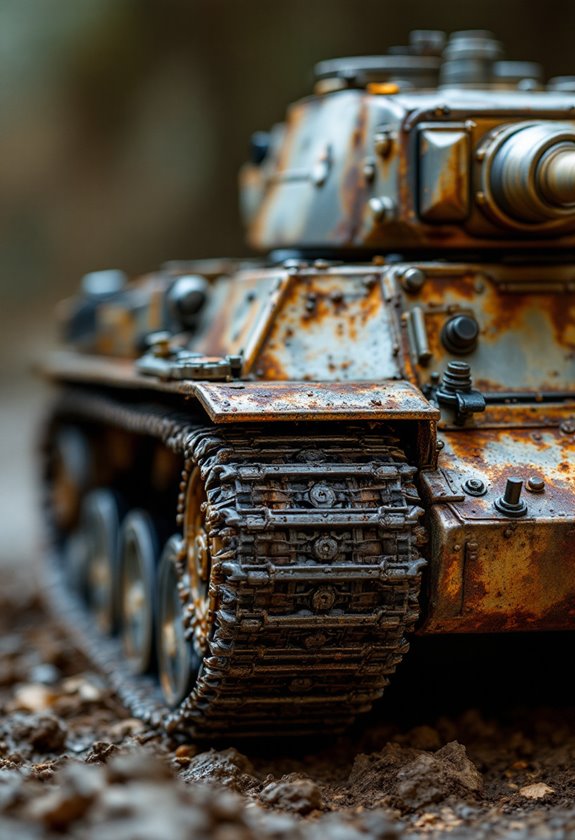
As remote-controlled (RC) technology evolved in the years following World War II, enthusiasts began to see the fascinating intersection of historical tanks and modern engineering. The advancement in scale accuracy has allowed RC models to mimic the complexities of original tanks, with various scales like 1:16 and 1:35 capturing intricate details. The mechanical complexity of these models has also increased, incorporating features such as proportional controls and realistic turret functions. Companies like Accurate Armor have elevated the hobby by utilizing advanced molding techniques, offering enthusiasts a chance to build authentic replicas that reflect genuine tank characteristics. This evolution fosters a community tied together by a shared passion for history and engineering, making RC tank modeling an engaging experience for many. Additionally, the inclusion of infrared combat systems has transformed multiplayer experiences, allowing enthusiasts to engage in realistic tank battles.
Recommended Products

Upgraded / Steel Gear Gearbox. More wear - resistant, service life multiplied

Upgraded / Metal road Wheel & Metal tracks & Metal Sprocket Wheel & Metal idle Wheel &Metal Suspension Arms

Upgraded / Metal road Wheel & Metal tracks & Metal Sprocket Wheel & Metal idle Wheel &Metal Suspension Arms
United States: RC Tank Advancements

The domain of RC tank advancements in the United States showcases a dynamic blend of historical reverence and cutting-edge technology, particularly exemplified by the development of the M4 Sherman tank replica. Hobbyist engagement has dramatically increased since the late 20th century, as collectors sought more intricate designs and operational features. Manufacturers now produce models with sturdy metal components, enhancing both realism and durability. These tanks serve as powerful tools for military education, allowing enthusiasts to explore history while operating sophisticated mechanical systems. The integration of sound modules and simulated battle capabilities fosters an engaging user experience. Overall, these advancements reflect a commitment to preserving historical authenticity while embracing modern technology, inviting both new and seasoned hobbyists to join the vibrant RC tank community. Additionally, the inclusion of features like realistic sound effects has significantly enhanced the immersive experience for users.
Recommended Products

Full Metal Construction: Upgraded with metal chassis, tracks, drive wheels, and cannon. This 1/16 scale M4A3E8 Sherman military vehicle offers maximum durability for adult hobbyists


Infrared Combating System Supports Many Players To Combat In A Tank War. 2.4Ghz Radio Control System, It Supports Many Similar Tanks Combating Together Without Radio Intervening.
Technical Features of WWII RC Tanks
WWII RC tanks are marvels of engineering, meticulously crafted to replicate the iconic vehicles that once roamed battlefield landscapes. Featuring exceptional scale accuracy, these RC tanks often operate at a predominant scale of 1:16, striking a balance between detail and manageability. Constructed with durable materials, such as steel bodies and metal transmission gears, they guarantee longevity during vigorous play.
Advanced propulsion technologies, primarily electric motors, provide clean and powerful movement, underpinned by gearboxes that offer realistic speed ratios. Control systems enable intricate maneuvers, including 360-degree turret rotation and simulated firing. Additions like realistic paint jobs and sound effects enhance immersion, appealing to collectors and hobbyists who cherish these historic replicas in both operation and display. Many models also include immersive sound effects and smoke simulations for a more authentic experience, adding to the overall enjoyment of the hobby.
Recommended Products

LED Lights: Integrated LED lights for realistic illumination, enhancing the visual appeal of the model during operation. Smoke Generator: Equipped with a smoke generator to simulate exhaust smoke, adding a layer of realism to the tank's performance.

Led Lights: Equipped With Realistic Led Lights For Enhanced Visual Experience, Providing Authenticity To The Model. Smoke Simulation: Incorporates A Smoke Simulation System.

Infrared combating system supports many players to combat in a tank war. 2.4Ghz radio control system, it supports many similar tanks combating together without radio intervening.
Historical Context of Remote-Controlled Military Vehicles
Remote-controlled military vehicles have a rich and fascinating history that stretches back to the early 20th century, marked by innovative research and experimental designs. During World War I, concepts of remote control began to take shape, advancing through the interwar period with British and French experiments on ground vehicles. Remarkable models include France’s *Véhicule Pommelet*, which served as a demolition carrier. The German Goliath tracked mine emerged in 1942, designed to carry explosives remotely, despite challenges like slow speed and vulnerability. Meanwhile, the U.S. Army converted B-17 bombers into drone bombers, showcasing the versatile military applications of remote control. These early efforts laid the groundwork for future advancements in unmanned warfare technology, blending imagination with military strategy.
Lasting Impact on Modern Warfare Technology
As military technology continues to evolve, the influences from World War II’s early experiments in remote-controlled vehicles remain profoundly significant in shaping modern warfare. These pioneering teletanks, like the Soviet TT-26, sparked a tactical evolution, leading to advanced autonomous systems used today for reconnaissance and combat.
Technological innovations in communication have transformed military operations, enabling real-time data sharing in modern tanks. Sensors such as thermal imaging have been integrated, enhancing accuracy and situational awareness beyond WWII capabilities.
As unmanned vehicles take on high-risk missions, modern doctrine emphasizes force multiplication—reducing human casualties while maximizing operational efficiency. The journey from teletanks to modern armored units illustrates a remarkable progression, underscoring the lasting impact of WWII’s remote-controlled vehicles on contemporary military strategies.
Frequently Asked Questions
What Were the Primary Motivations Behind Developing Remote-Controlled Tanks in WWII?
The primary motivations behind developing remote-controlled tanks in WWII included gaining tactical advantage, enhancing operational efficiency, and utilizing psychological warfare to intimidate opponents. These innovations safeguarded personnel while optimizing battlefield effectiveness through advanced technological experimentation.
How Did the Technology of WWII RC Tanks Influence Modern Military Vehicles?
Like seeds sown in wartime soil, WWII remote-controlled tanks nurtured modern adaptations of military innovations. Their foundational technologies, such as centralized control systems and robust communication, shaped today’s unmanned vehicles, enhancing efficiency and minimizing risk on the battlefield.
Were There Any Significant Failures in Early Remote-Controlled Tank Designs?
Early remote-controlled tank designs faced significant failures due to design limitations and operational failures. Control systems proved unreliable, weaponry ineffective, and environmental challenges rendered these innovations largely ineffective on the battlefield, questioning their true practicality and intent.
What Were the Main Challenges Faced During the Operation of WWII Teletanks?
The operational limitations of WWII teletanks, coupled with their tactical disadvantages, hindered effectiveness. Poor visibility, communication challenges, and restricted maneuverability notably reduced their combat utility, often relegating them to secondary roles rather than frontline engagements.
Did Any Countries Develop Successful Combat Models Using Remote-Controlled Technology?
Like fleeting shadows, remote-controlled combat models eluded major nations during WWII, overshadowed by technological limitations. Despite Germany’s Goliath, true combat effectiveness remained a distant dream, leaving only echoes of ambition in the battlefield’s memory.